Posted on 26 January 2011. Tags: curriculum, kids yoga, kids yoga poses, language, teaching yoga in school, teaching yoga to kids, yoga for literacy, yoga games
If you're new here, you may want to subscribe to my RSS feed. Thanks for visiting!
I teach a lot of pre-school to Grade 3 students and am always developing fun, engaging, and educational yoga classes for this age group. When I received a set of the Learn With Yoga ABC Yoga Cards for Kids I knew this resource was a winner.
Conveniently packaged in a sturdy box, these 52 over-sized cards (two for each letter of the alphabet) are easy to use, kid friendly and packed with educational potential. I’ve used this card deck extensively over the past month. Every time it has been a hit with students, educators and parents, many of whom have asked where they can pick up their own set.
Research shows that learning is enhanced through movement. The ABC Yoga Cards for Kids helps parents, teachers and yoga instructors develop age and ability appropriate lessons which are fun and meaningful.
What sets this card deck apart is the accompanying instructor card which corresponds to the pose card. Here you’ll find all kinds of helpful suggestions for developing reading readiness, questions to stimulate further discussion and inquiry, and early learning skills helps such as categorization, attributes, opposites and spatial concepts.
Developed by Christine Ristuccia, a Speech-Language Pathologist, this deck of cards goes above and beyond the ABCs of yoga for young children. To truly explore the many ways this resource can be applied to language learning Ristuccia has poured an immense amount of knowledge and skill into the accompanying ABC Yoga Card for Kids Instructor Guide. What I really appreciate is the breakdown of exactly how to use yoga to enhance language skills into ages, from 12 months to 8 years old. I swear the entire Chapter 2 of this manual is highlighted in my copy.
Addriya has generously provided a Learn with Yoga Package Set (retail value of $54.95 USD) to one lucky Yogainmyschool.com reader. This set includes:
- one deck of ABC Yoga Card for Kids
- a copy of the ABC Yoga Cards for Kids Instructor Guide
- a Yoga for Kids Classroom Border
These products can be purchased separately or as a set from the Addriya on-line store.
To enter to win leave a comment below telling how you’d use these resources.
Additional Entries:
- Follow Addriya Yogaon Facebook and comment back here
- Share this review on Facebook with an @yogainmyschool.com mention (multiple entries allowed)
- Tweet it including an @DonnaKFreeman mention (multiple entries allowed): “ABC Yoga Card for Kids #giveaway @DonnaKFreeman @addriya“
Draw date is January 31, 2011 at 8:00 pm MST. Enter often – you definitely want this in your kids yoga library of resources!
Update: Congrats to Bryan who won the Learn with Yoga Package Set. Upon learning of his good fortune he said:
I’m always thrilled to find new ways of bringing yoga to children — I’m actually on my way to lead a yoga and art class for 1st and 2nd graders, and can’t wait to bring the yoga cards in with me next week
“Once Upon a Pose” seems to come with me to every kids yoga class I teach, too, so thanks a bunch for all these great resources.
Thanks to everyone who participated in this give-away. Watch for our monthly reviews of great yoga resources to use in your classes.
4 people like this post.
Posted in curriculum applications, give aways, kids yoga, products-kids, yoga games, yoga in school
Posted on 24 January 2011. Tags: benefits, curriculum, kids yoga, kids yoga poses, poses, science, teaching yoga in school, teaching yoga to kids, yoga
In this video we demonstrate how to teach three bug yoga poses: butterfly pose, dead bug pose and spider pose. This is a fun activity for children who are interested in the outdoors and the many creepy crawlies found there. It is also an ideal way to incorporate yoga into the science curriculum or a unit on insects and engage kinaesthetic learning.
Bug Yoga
Preschool children love bugs. So today we are going to learn how to do some Bug Yoga. I’ve got Garner and Marcus here to help me.
The first pose we are going to do is butterfly pose. This pose stimulates the heart and stretches the thighs. You can tell the differences between a butterfly and a moth by the directions that their wings stay when they are at rest.
The second pose that we are going to do is dead bug pose. This is a great activity to open the hips and build listening skills.
The third bug pose that we are going to do today is spider pose. Sitting in row like a train while in easy pose we are going to sing the song Itsy Bitsy Spider. Switch places and sing various versions of the song. For example: The Edmonton Spider.
The Edmonton spider went up the water spout
Down came the snow and froze the spider out
Out came the sun and it didn’t do a thing
So the Edmonton spider stayed frozen until spring.
I hope you have enjoyed Bug Yoga today. The next time that you are out walking and your kids are totally engrossed in the creepy crawlies across the sidewalk make sure you come home and do some bug yoga and get them into their bodies, into their minds, into their spirits. For more ideas on teaching kids and teens yoga please visit http://www.yogainmyschool.com. Namaste.
What other Bug Yoga poses can you think of?
1 person likes this post.
Posted in creative, curriculum applications, fun, kids yoga, poses, videos, yoga in school
Posted on 12 November 2010. Tags: curriculum, kids yoga, kids yoga, language, school, teaching, teaching yoga in school, teaching yoga to kids, teaching yoga to teenagers, teens yoga, yoga
In a previous life (or at least sometimes it feels that way) I was a French teacher. French was in fact my third language after spending a year in Brazil as an exchange student picking up Portuguese along the way. When I decided to learn French I knew that the most effective way to learn a language was through immersion because then it wasn’t simply a subject in school. The language became a tool for living whether it was taking the bus and knowing which stop to get off at or ordering from a menu to get the food I wished to eat. So off I went to the Faculté St Jean in Edmonton, Alberta, Canada to study.
Slowly French began to seep into my brain. I quickly discovered I retained more the days I rode my bike to and from campus, which thank heavens was most days, even when it was -20° celsius and snowing. The language also opened an entire culture and the world became more reachable, the people more understandable.
Years later while living in Cape Town, South Africa I was introduced to yoga. It was love at first pose. Immediately I began to look for ways to incorporate my language background with this new endeavor. The interconnections between mind and body were like learning an entirely new language, this time the one spoken of by my mind and body. I began to more fully understand the Upanishads where it says:
It is not the language but the speaker we want to understand.
Combining my two loves I realized that yoga provides a wonderful avenue for introducing foreign language education to children and youth. There are two ways this is done. 1) Yoga in the second language classroom and 2) second language usage in the yoga classroom.
Yoga in the Second Language Classroom
It has been proven that exercise increases neural pathways and neurogenesis (see Brain Rules #1Exercise Boosts Brain Power). Increased movement makes us more alert, provides a better sense of well-being and improves memory. Using yoga in the classroom allows teachers to harness the power of movement and to create an enriched learning environment. Yoga is easy to incorporate into the classroom as it requires no additional equipment, is adaptable to all individuals, can be done alone, with partners or in a group, and has a flexible time requirement (as little as one breath to an entire period).
In addition yoga partner poses, such as Tricky Tree and Two Scoops, provide a unique opportunity to engage learners in cooperative work requiring communication (in the target language, of course). Yoga Jenga, Swami Says and other yoga games will also encourage students to use their bodies and communication skills while having fun. Using yoga in adventure stories will increase vocabulary and maintain interest and attention.
Second Languages in Yoga Class
Second languages are easy to incorporate into yoga class. In fact, most yoga instructors will use Sanskrit terms for poses (asanas,) breathing (pranayama) and relaxation (savasana). Where ever you go in the world Sanskrit is the international language of yoga. You may not know which pose is “l’aigle” but if they say “garudanasa” then you are set. If you are unfamiliar with the Sanskrit names the alphabetical list of poses provides the English and Sanskrit names for each. In addition, the Online Sanskrit Pronunciation Guide will prove invaluable to acquaint learners with proper pronunciation.
Other languages are also easy to incorporate into yoga class in creative and fun ways. Positive attitudes toward target languages and speakers will result, as will improved cognitive development. Second language acquistion promotes more complete and more complex connections between the right and left hemipsheres of the brain. So not only will children have increased body memory, they will also have improved communication skills and greater appreciation for the world.
Here are a list of resources which will prove useful when using yoga for foreign language learning.
Kids Yoga Resources in Foreign Languages
BYKI is a great site to learn languages on line with free resources in 70 languages.
1 person likes this post.
Posted in curriculum applications, yoga in school
Posted on 08 November 2010. Tags: class, curriculum, kids yoga, kids yoga poses, language, math, partner pose, school, teaching yoga in school, teaching yoga to kids, yogainmyschool
Tricky Tree group yoga pose develops concentration and focus while improving balance and memory. This is an ideal pose to get students working together and is a lot of fun as our three yogis demonstrate. By employing this pose children are able to access kinaesthetic learning, engaging their minds and bodies to review a basic learning skill such as counting by twos, multiplication tables, spelling words or in this case repeating the days of the week in French. In addition, they develop their social skills by learning to work together communicating verbally and non-verbally with one another.
Tricky Tree: Group Yoga Pose
In order to build focus and concentration a great pose is Tricky Tree. This is a partner or group pose.
Facing your partner or into the group, everyone needs to raise the same leg and give it to the person standing beside them. In this case we are going to raise the right leg, giving to the person at our right. This takes some teamwork and a lot of balance.
So once you are in the pose, you can then repeat something which requires rote memorization such as the days of the week in French.
dimanche, lundi, mardi, mercredi, jeudi, vendredi, samedi
When you are finished its nice to either step out of the pose, or if you are in a safe environment with no sharp edges, you can gently fall to the floor.
And that’s Tricky Tree.
Be sure to subscribe to our YouTube Channel for more great videos on teaching yoga to kids and teens.
1 person likes this post.
Posted in curriculum applications, poses, videos, yoga in school
Posted on 29 September 2010. Tags: curriculum, health, how to, kids yoga, kids yoga, labyrinths, language, math, mindfulness, science, teaching yoga in school, teaching yoga to kids, teaching yoga to teenagers, yoga
So you’re somewhat interested in labyrinths and the kids find them a great place to skip along a path and play, but what’s the point? What can one learn from walking a labyrinth or tracing a finger labyrinth? The answer: all kinds of great things from focus to mathematical formulas. Here is a list of some of the ways labyrinths can be used as a learning tool with children and teenagers.
Mindfulness
Labyrinths are a right brain meditation activity. In other words labyrinths develop creativity and imagination while focusing and calming the mind and body. Using labyrinths as mindfulness tools will reduce stress and increase concentration helping to create an optimum learning environment in the classroom.
Gross Motor Skills
Whether you are walking precisely, hopping, skipping, or playing along the path, a labyrinth will develop gross motor skills such as coordination, balance, body awareness, and spatial orientation. These skills are essential to proper physical development in children and also prepare the body for fine motor skills.
Fine Motor Skills
Finger labyrinths help refine fine motor skills. Using a finger or pen to follow the path in to the center and out again requires concentration and develops the small muscle movements in the hands as well as finger/eye coordination. Coloring labyrinths furthers this development.
Social Studies
Labyrinths are found throughout the world. Explore numerous countries (France, Italy, Estonia, Sweden, India - use the World Wide Labyrinth Locator for more) and cultures (Roman, Greek, Hopi, Religious) to learn the use and symbolism of labyrinths.
Language Arts
Labyrinths have been used as a metaphor, cultural symbol and narrative structure in literature and film. Examining their use and various examples throughout history is an interesting and illuminating journey. Journaling about any lessons learned or insights gained while walking a labyrinth is a valuable self reflection exercise. Here are some observations from youth.
Math
From patterns to advanced calculations, labyrinths are a mathematicians playground. Understand patterns by learning to draw a labyrinth. Tony Philips provides lesson plans and activities which connect math with labyrinths here. Examine the geometry of various labyrinths.
Science
Build a labyrinth out of materials used during science lessons: tulip labyrinth, rock collection. Observe local bird species with the help of a birdseed labyrinth. Celebrate Earth Day by building a labryrinth with found items in nature: sticks, leaves, twigs, rocks, sea weed, grass, etc.
Physical Education
Walk, run, skip, hop, jump, backwards, forwards or sideways through the labyrinth. Get the heart rate up or bring it down. Compare how your body feels and the energy various activities create. In the winter enjoy building a snow labyrinth with snowshoes.
Be the first to like.
Posted in creative, curriculum applications, fun, kids yoga, mindfulness, teens yoga, yoga basics, yoga in school
Posted on 27 September 2010. Tags: curriculum, kids yoga, kids yoga, labyrinths, mindfulness, teaching yoga in school, teaching yoga to kids, teaching yoga to teenagers, yogainmyschool
Welcome to labyrinth week. This week we’ll be exploring the wonderful world of labyrinths and how children and teens can use these ancient tools to discover themselves, learn mindfulness, reduce stress, increase fine and gross motor skills, practice math, gain appreciation for nature, explore world history and much more.
To kick off the week we have an interview with Rev. N. Elaine Nagy, the Labyrinth Facilitator at the St Albert United Church, where on the last Friday of every month they hold a labyrinth walk.
Q: What is a labyrinth?
A: It’s a path. The kind of labyrinths that we use in place like a church, or in a garden, it’s a path that’s used often to help people connect with something beyond themselves.
Q: Why do people walk labyrinths?
A: The reason I walk a labyrinth is that I find it an easier way for me to connect with God. Lots of times people who start walking labyrinths have had some big change happen in their life. They are sad for some reason, or they are having to make a big decision, and so when they walk on the labyrinth it is an opportunity to let go of what’s bothering them, it’s an opportunity for them to understand what they are worried about in a new way. And sometimes it helps them to feel a lot better about what is going on, so that they feel more peaceful.
Q: Where are some famous labyrinths?
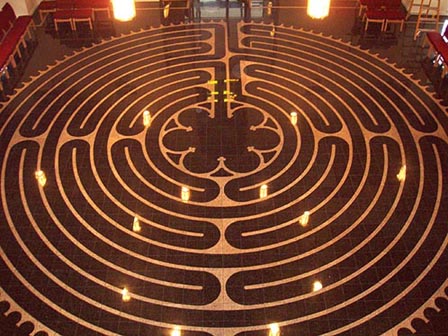
A: The most famous labyrinth in the world is in Chartres Cathedral in France which is about 45-60 minutes by train to the west of Paris. The reason its so famous is that is the only labyrinth from the middle ages left intact in a church. I’ve been to that labyrinth. It’s a stone labyrinth in the floor. This is a picture of it right here. Labyrinths used to be popular for hundreds of years and then they fell into disuse and so they got ripped out. The story I like to tell about this labyrinth is that it used to have copper in the center of it but it doesn’t anymore because Napoleon needed the copper. He was a famous leader in France. He was so desperate for metal to fight his wars that he even took the copper out of the middle of the labyrinth for his cannons and for metal to fight his enemies.
They say that originally that piece of copper had a Greek mythical figure in it because even though it is old, there are labyrinths that are much older: in Greece, in Crete. There are labyrinths there that are thousands of years old. And then among the Hopi people of Arizona they have labyrinths that are very old too. Labyrinths have been found in rocks and caves, thousands and thousands of years old, in different parts of the world. But the one in Charters you can actually see and still walk.
Q: Do you have any advice when walking a labyrinth?
A: My biggest advice would be to not treat it like a toy, but to treat it like something special. It’s not a trick. It’s not a puzzle. It’s a special place. The same way that you probably have special places you’ve been, someplace you’ve been on vacation, or grandma’s house, or someplace you like to be. I hope that a labyrinth might be a place that you enjoy going to. Whether just to be alone with yourself, or to think about something, or to just feel good and peaceful. So if you treat it like that, rather than a place for playing games, though children love to be free and to run in labyrinths and that’s a good thing. Always remember that it is a special place and that it’s meant not only for us to enjoy but for us to connect with something bigger than ourselves. I think my advice would be enjoy them, but always remember that it’s a special place.
Thank you.
Thank you for asking.
1 person likes this post.
Posted in kids yoga, meditation, relaxation, videos, yoga in school