Posted on 19 August 2011. Tags: benefits, kids yoga, philosophy, school, teaching yoga to kids, teaching yoga to teenagers, yogainmyschool
If you're new here, you may want to subscribe to my RSS feed. Thanks for visiting!
Yoga Skills For Your Backpack
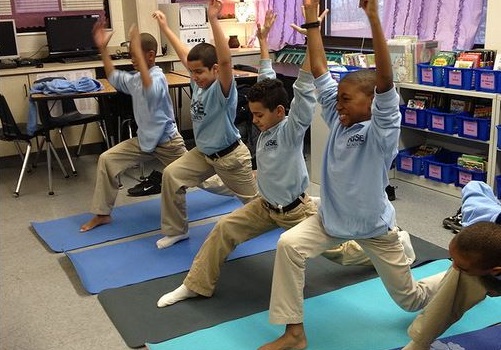
It’s back to school time and families everywhere are busy buying supplies, sharpening pencils and trying to resume something of a schedule after a summer filled with adventures, sun and free time to explore and grow. Thankfully our summer yoga practice (gotta love yoga in the park and yoga camp) has provided a wonderful foundation for the kids as they head back to school. Here are some yoga ABC’s which will help youth succeed in the classroom as well as in life. Be sure to include them in your child’s backpack along with the books, paper, markers and other essential school supplies.
A is for Attitude
Your attitude will influence every aspect of your life. When you approach your yoga practice with joyful enthusiasm, it is a creative, energetic, fluid experience. If you begrudgingly hit the mat you’re not going to get as much out of it, though you will feel better from moving your body and engaging your mind. Know that how you approach your school day will impact what you get out of it. Be positive. You’ve got to be there anyway, you may as well eek as much joy out of it as possible.
B is for Basics
When learning yoga asanas (poses) you start with beginner poses and work toward a more advanced, subtle expression of the postures. So it is with school work. You’ve got to master addition and subtraction before moving onto algebra. Sometimes we want to rush through the beginning stages to get to the fancy stuff, but the basic work and practice we do lays an important foundation to future growth and learning.
C is for Confidence
Remember how it felt the first time you rocked Half Moon Pose, Crow Pose or another pose you’d been working on? I do! Keep that feeling in mind at school. Be confident that you can meet any challenge. Be your best, giving genuine effort, and you just might surprise yourself. Let go of others opinions. Don’t worry if you are one of the popular crowd or not. Be yourself and know that you are amazing.
D is for Deliberate
When coming into yoga poses you follow specific instructions on where to place your feet, hands and other body parts. As you deliberately follow these instructions you are able to a achieve nuanced, energetic pose which at first glance may have appeared impossible. Be deliberate at school as well. Listen to your teachers. Follow instructions carefully. Proceed one step at at time. For example in yoga we do inward spiral before outward spiral. There is a reason to this. Be deliberate as you engage in school work. The results are well worth it.
E is for Energy
Prana (life force) resides within each one of us. We are able to direct, control and change our energy through breathing, meditation and asana practice. Strive to cultivate a calm, receptive energy. At times you may need to increase your energy through vigorous practice. Other times you may need to become more grounded and centered. Know that you are in charge and can influence your physical, mental and emotional energy.
F is for Focus
Ah, Tree Pose…so many lessons, one of which is single minded focus. Transfer that ability to the classroom and you will be a successful student. Focusing on and completing assignments, homework and other tasks is essential. There are tons of distractions which can interfere with the important work of learning. Focus on what needs to be done, get it done, then enjoy a sense of accomplishment while you indulge in your distraction of choice.
There I’ve got you started. Practicing yoga with kids and teens helps equip them with essential skills which will help them to do their enthusiastic best in and out of the classroom. Remember that what we learn on the mat are lessons for life. What other essential yoga ABC’s can you think of?
2 people like this post.
Posted in kids yoga, teens yoga, yoga basics, yoga in school
Posted on 21 April 2011. Tags: earth day, environment, how to, myEARTH360, positive, school, teaching
Lynn Hasselberger, founder of myEARTH360, is a woman on a mission to make everyday living environmentally friendly, kind to both people and the environment. Fueled by her eco-passion, she started with custom designed reusable water bottles for kids and has since developed an entire site packed with items from eco-friendly school supplies to green pet products as well as providing eco news and tips on her blog. Lynn joins us to talk about sustainable living with tips on how to make every day Earth Day and much more.
Original Air Date: April 21, 2011
Audio clip: Adobe Flash Player (version 9 or above) is required to play this audio clip. Download the latest version here. You also need to have JavaScript enabled in your browser.
Connect with Lynn on Facebook or Twitter and be sure to check out all the inspiring eco-loving products on myEARTH360.com. The wildflower notecards are my fave!
Coming on May 4th our next interview will feature blissologist Eoin Finn. Don’t miss his 5 Big Easys to discovering bliss.
1 person likes this post.
Posted in curriculum applications, interviews
Posted on 14 March 2011. Tags: benefits, curriculum, kids yoga, language, school, teaching yoga in school, teaching yoga to kids, yoga, yoga for literacy, yogainmyschool
How Yoga Promotes Early Literacy Skills
Well thought out kids yoga classes can assist in developing literacy skills. Learning to read is a key skill acquired between the ages of 4 and 7 years old. Most academic and career accomplishments depend on success in building a solid reading foundation in Grades 1-3. A children’s yoga class can facilitate this process in numerous ways thereby supporting lifelong reading competency.
Build Phonemic Awareness
Phonemic awareness is the ability to distinguish sounds (phonemes) in spoken language and is an essential auditory process for emergent readers. Incorporating segmenting, alliteration and rhyming into kids yoga classes are easy ways to facilitate phonemic awareness. Using music and nursery rhymes when teaching poses also develops sound appreciation. One such example is when practicing Bridge pose you may include the instructions “Build a bridge, bring your bottom to the sky” (alliteration) or sing London Bridge Is Falling Down.
Increase Vocabulary & Comprehension
Kids yoga classes contribute to the background of real world experience. Children are exposed to a wide range of vocabulary while following instructions to complete poses, discussing themes and participating in guided visualizations. This exposure combined with movement and relaxation builds neural systems and improves comprehension which carries over into the classroom.
Enhance Self Esteem & Self Regulation
How a child feels about themselves impacts their ability to learn. Yoga teaches self-acceptance, kindness and discipline in a non-competitive environment where children are encouraged to learn about their bodies, their minds and their emotions. Breathing exercises and visualizations teach focus, relaxation and body awareness. In addition, meditation and mindfulness techniques improve self-regulation which has been linked to the development of reading competence as children mature.
Teacher Training in Yoga for Literacy
Well trained kids yoga instructors will incorporate reading readiness strategies into their classes for children. Yogainmyschool.com offers teacher training on Yoga for Literacy; please contact donna@yogainmyschool.com for more information.
4 people like this post.
Posted in curriculum applications, kids yoga, yoga in school
Posted on 12 November 2010. Tags: curriculum, kids yoga, kids yoga, language, school, teaching, teaching yoga in school, teaching yoga to kids, teaching yoga to teenagers, teens yoga, yoga
In a previous life (or at least sometimes it feels that way) I was a French teacher. French was in fact my third language after spending a year in Brazil as an exchange student picking up Portuguese along the way. When I decided to learn French I knew that the most effective way to learn a language was through immersion because then it wasn’t simply a subject in school. The language became a tool for living whether it was taking the bus and knowing which stop to get off at or ordering from a menu to get the food I wished to eat. So off I went to the Faculté St Jean in Edmonton, Alberta, Canada to study.
Slowly French began to seep into my brain. I quickly discovered I retained more the days I rode my bike to and from campus, which thank heavens was most days, even when it was -20° celsius and snowing. The language also opened an entire culture and the world became more reachable, the people more understandable.
Years later while living in Cape Town, South Africa I was introduced to yoga. It was love at first pose. Immediately I began to look for ways to incorporate my language background with this new endeavor. The interconnections between mind and body were like learning an entirely new language, this time the one spoken of by my mind and body. I began to more fully understand the Upanishads where it says:
It is not the language but the speaker we want to understand.
Combining my two loves I realized that yoga provides a wonderful avenue for introducing foreign language education to children and youth. There are two ways this is done. 1) Yoga in the second language classroom and 2) second language usage in the yoga classroom.
Yoga in the Second Language Classroom
It has been proven that exercise increases neural pathways and neurogenesis (see Brain Rules #1Exercise Boosts Brain Power). Increased movement makes us more alert, provides a better sense of well-being and improves memory. Using yoga in the classroom allows teachers to harness the power of movement and to create an enriched learning environment. Yoga is easy to incorporate into the classroom as it requires no additional equipment, is adaptable to all individuals, can be done alone, with partners or in a group, and has a flexible time requirement (as little as one breath to an entire period).
In addition yoga partner poses, such as Tricky Tree and Two Scoops, provide a unique opportunity to engage learners in cooperative work requiring communication (in the target language, of course). Yoga Jenga, Swami Says and other yoga games will also encourage students to use their bodies and communication skills while having fun. Using yoga in adventure stories will increase vocabulary and maintain interest and attention.
Second Languages in Yoga Class
Second languages are easy to incorporate into yoga class. In fact, most yoga instructors will use Sanskrit terms for poses (asanas,) breathing (pranayama) and relaxation (savasana). Where ever you go in the world Sanskrit is the international language of yoga. You may not know which pose is “l’aigle” but if they say “garudanasa” then you are set. If you are unfamiliar with the Sanskrit names the alphabetical list of poses provides the English and Sanskrit names for each. In addition, the Online Sanskrit Pronunciation Guide will prove invaluable to acquaint learners with proper pronunciation.
Other languages are also easy to incorporate into yoga class in creative and fun ways. Positive attitudes toward target languages and speakers will result, as will improved cognitive development. Second language acquistion promotes more complete and more complex connections between the right and left hemipsheres of the brain. So not only will children have increased body memory, they will also have improved communication skills and greater appreciation for the world.
Here are a list of resources which will prove useful when using yoga for foreign language learning.
Kids Yoga Resources in Foreign Languages
BYKI is a great site to learn languages on line with free resources in 70 languages.
1 person likes this post.
Posted in curriculum applications, yoga in school
Posted on 08 November 2010. Tags: class, curriculum, kids yoga, kids yoga poses, language, math, partner pose, school, teaching yoga in school, teaching yoga to kids, yogainmyschool
Tricky Tree group yoga pose develops concentration and focus while improving balance and memory. This is an ideal pose to get students working together and is a lot of fun as our three yogis demonstrate. By employing this pose children are able to access kinaesthetic learning, engaging their minds and bodies to review a basic learning skill such as counting by twos, multiplication tables, spelling words or in this case repeating the days of the week in French. In addition, they develop their social skills by learning to work together communicating verbally and non-verbally with one another.
Tricky Tree: Group Yoga Pose
In order to build focus and concentration a great pose is Tricky Tree. This is a partner or group pose.
Facing your partner or into the group, everyone needs to raise the same leg and give it to the person standing beside them. In this case we are going to raise the right leg, giving to the person at our right. This takes some teamwork and a lot of balance.
So once you are in the pose, you can then repeat something which requires rote memorization such as the days of the week in French.
dimanche, lundi, mardi, mercredi, jeudi, vendredi, samedi
When you are finished its nice to either step out of the pose, or if you are in a safe environment with no sharp edges, you can gently fall to the floor.
And that’s Tricky Tree.
Be sure to subscribe to our YouTube Channel for more great videos on teaching yoga to kids and teens.
1 person likes this post.
Posted in curriculum applications, poses, videos, yoga in school
Posted on 06 October 2010. Tags: Australia, challenge, kids yoga, school, teaching, teaching yoga in school, teaching yoga to kids, teaching yoga to teenagers, yoga
Guest post by Andrea Windsor
I have been practicing yoga for 12 years and have been teaching for 3 years. I have been passionate about yoga for years but I always felt a sense of lack around my teaching, as though each adult class was not quite right for me, as though we didn’t fit. The classes were always well attended and the students were happy and content but I believe the unrest was coming from within me.
I have 4 children of my own; the youngest is now 16 so I am quite experienced with children and teenagers. I had an idea when my daughter was in her final year of secondary college to teach yoga on a voluntary basis and see where it took me.
It was extremely (and surprisingly) successful. We began with a full class, about 20 teenagers aged around 17 to 18 years of age and after the 10 week course we had a steady class of 10 to 12. I was very happy and so were the kids. It was so successful that the school requested it for the next year and offered me payment for the classes. At that time I was working for another yoga teacher and was still completing my training.
I had a break from teaching kids for a couple of years after that but felt the calling again earlier this year. I am now in the process of setting up my own yoga business, focusing on teaching teenagers in schools and community centers.
It’s quite a risky move for me as I will probably need to give up my present job (as a massage therapist) from which I earn my income so I can dedicate the time needed to make the yoga one work. My intuition is telling me it will be ok. I have one placement already teaching Koorie (aboriginal) teenagers in a school nearby. They would like one class that runs for one hour per week. This is quite a specialized area as these kids are disadvantaged for various reasons and are not suitable for regular schools. I begin this class in about 3 weeks.
For the last 10 weeks I have been teaching year 9 (about 14 to 15 years of age) teenagers at the local secondary school. For the first few classes they were a little self conscious around asanas, the girls especially found them challenging. I think they were embarrassed to move their bodies in that way. They were pretty much over that by week 4 and haven’t looked back since then. They love the relaxation and breath awareness at the beginning and end of class. In the last few weeks they were saying “can you take us to our happy place?’… that was so thrilling for me for me to hear that.
I look forward to the challenges ahead and it feels great to know that I may be planting a small seed in the minds and hearts of our young people, even if they just remember to be aware of their breath sometimes I think it will be worth it.
Andrea Windsor lives in rural Victoria, Australia, on 5 acres of land with three of her four children. She practices Satyananda Yoga.
3 people like this post.
Posted in teens yoga, yoga basics, yoga in school