Tag Archive | "math"

Yoga Game: Lost My Shape


Bookmark and Share

Shapes are everywhere. They provide us with a way to organize and make sense of our world. Once you are familiar with basic shapes, you see them all around you. You begin to combine shapes to make other shapes.

This is one of the kids yoga games included in the new booklet Shapes: A Kids Yoga Class. Lost My Shape is great fun and gets everyone moving, playing and making shapes. It develops critical thinking, analysis and observation skills and allows children an opportunity to apply knowledge in a fun, cooperative, interactive manner.

Lost My Shape

Have students sit in a circle.

Step 1: Have 3-6 students (or more if you have a large group) in the middle of the circle each assigned a different shape using the shapes cards found the the booklet Shapes: A Kids Yoga Class. Show them the card and verify they know now to make it. Don’t make it with their body until the singing begins.

Step 2: One other student is “IT” and he/she randomly picks one card from the shape cards used in Step 1. Don’t show it to anyone. This student skips/walks around the circle during Step 3.

Step 3: Everyone sings to the tune of “Skip to My Lou”

Lost my shape, what do I do,

Lost my shape, what do I do,

Lost my shape, what do I do,

Skip to my lou, my darling.

During the singing, students in the center of the circle make their shapes while “IT” skips around. When the song is over “IT” picks the student from the middle to match their shape card.

This student then becomes “IT,” new students are selected to go in the middle of the circle and you play again.

For more Shape Yoga check out the booklet Shapes: A Kids Yoga Class -15 pages packed with ideas on how to teach shapes using yoga, mindfulness, mudras and more. Find it HERE.


Looking for more kids yoga games? Enjoy the many found on the Yoga Games Page.

1 person likes this post.

Posted in fun, kids yoga, yoga games, yoga in schoolComments (0)

Shapes: A Kids Yoga Class


Bookmark and Share

Teaching Shapes with Yoga

Using yoga as a tool to learn shapes is fun, kinaesthetic learning at its best.

Children are able to become the shapes in various forms and sizes, using their hands, their bodies and their friends. This is an ideal way for children to experience and explore the world and move from non-verbal, physical understanding to abstract, mental comprehension. Performing shape yoga helps children grasp, internalize, and retain concepts in a creative and informative manner. In addition, using yoga to teach shapes improves communication, cooperation, problem-solving, creative thinking, analysis, observation and other skills key to success in school and life.

Learn Shapes Easily with Kids Yoga

The booklet, Shapes: A Kids Yoga Class, is ideal for pre-school, kindergarten and elementary school classes. I have taught this class with children aged 2-12 in schools, day cares, kids and family yoga classes, and at yoga summer camps. There are lots of ideas for various ages so use what works best for your group.

Have fun and play shape yoga today!

Shapes: A Kids Yoga Class
Shape yoga makes learning playful, novel and enjoyable: exactly what young children love. The 15 page booklet is packed with ideas on how to create shapes using yoga including mudrās (hand gestures), individual, partner and group poses, breathing exercises, mindfulness techniques, and a guided visualization. There are also numerous additional resources (games, music, crafts, books, flashcards) to support your shape yoga experience. Have fun and play shape yoga today!
Price: $7.93

Shapes: A Kids Yoga Class includes mudrās and poses for:

  • circle
  • diamond
  • triangle
  • star
  • crescent
  • rectangle
  • zig-zag
  • heart

Additional resources:

  • Yoga Games including – What Shape am I?, Lost My Shape, Shape Tumbling, Shape Patterns, Star/Black Hole
  • Music suggestions
  • Numerous links to crafts, printables, worksheets, mandalas
  • 10 Children’s literature recommendations
  • Guided Visualization (perfect for savasana)
  • Shape Flashcards
6 people like this post.

Posted in creative, curriculum applications, featured, fun, kids yoga, products-kids, yoga games, yoga in schoolComments (1)

Tricky Tree: Yoga in the Classroom


Bookmark and Share

 Tricky Tree group yoga pose develops concentration and focus while improving balance and memory. This is an ideal pose to get students working together and is a lot of fun as our three yogis demonstrate. By employing this pose children are able to access kinaesthetic learning, engaging their minds and bodies to review a basic learning skill such as counting by twos, multiplication tables, spelling words or in this case repeating the days of the week in French. In addition, they develop their social skills by learning to work together communicating verbally and non-verbally with one another. 

Tricky Tree: Group Yoga Pose

In order to build focus and concentration a great pose is Tricky Tree. This is a partner or group pose.

Facing your partner or into the group, everyone needs to raise the same leg and give it to the person standing beside them. In this case we are going to raise the right leg, giving to the person at our right. This takes some teamwork and a lot of balance.

So once you are in the pose, you can then repeat something which requires rote memorization such as the days of the week in French.

dimanche, lundi, mardi, mercredi, jeudi, vendredi, samedi

When you are finished its nice to either step out of the pose, or if you are in a safe environment with no sharp edges, you can gently fall to the floor.

And that’s Tricky Tree.

Be sure to subscribe to our YouTube Channel for more great videos on teaching yoga to kids and teens.

1 person likes this post.

Posted in curriculum applications, poses, videos, yoga in schoolComments (2)

Labyrinths in the Classroom: A Cross Curricular Learning Tool


Bookmark and Share

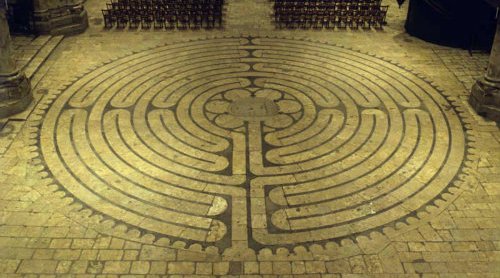
So you’re somewhat interested in labyrinths and the kids find them a great place to skip along a path and play, but what’s the point? What can one learn from walking a labyrinth or tracing a finger labyrinth? The answer: all kinds of great things from focus to mathematical formulas. Here is a list of some of the ways labyrinths can be used as a learning tool with children and teenagers.

Mindfulness

Labyrinths are a right brain meditation activity. In other words labyrinths develop creativity and imagination while focusing and calming the mind and body. Using labyrinths as mindfulness tools will reduce stress and increase concentration helping to create an optimum learning environment in the classroom.

Gross Motor Skills

Whether you are walking precisely, hopping, skipping, or playing along the path, a labyrinth will develop gross motor skills such as coordination, balance, body awareness, and spatial orientation. These skills are essential to proper physical development in children and also prepare the body for fine motor skills.

Fine Motor Skills

Finger labyrinths help refine fine motor skills. Using a finger or pen to follow the path in to the center and out again requires concentration and develops the small muscle movements in the hands as well as finger/eye coordination. Coloring labyrinths furthers this development.

Social Studies

Labyrinths are found throughout the world. Explore numerous countries (France, Italy, Estonia, Sweden, India - use the World Wide Labyrinth Locator for more)  and cultures (Roman, Greek, Hopi, Religious) to learn the use and symbolism of labyrinths.

Language Arts

Labyrinths have been used as a metaphor, cultural symbol and narrative structure in literature and film. Examining their use and various examples throughout history is an interesting and illuminating journey. Journaling about any lessons learned or insights gained while walking a labyrinth is a valuable self reflection exercise. Here are some observations from youth.

Math

From patterns to advanced calculations, labyrinths are a mathematicians playground. Understand patterns by learning to draw a labyrinth. Tony Philips provides lesson plans and activities which connect math with labyrinths here. Examine the geometry of various labyrinths.

Science

Build a labyrinth out of materials used during science lessons: tulip labyrinth, rock collection. Observe local bird species with the help of a birdseed labyrinth. Celebrate Earth Day by building a labryrinth with found items in nature: sticks, leaves, twigs, rocks, sea weed, grass, etc.

Physical Education

Walk, run, skip, hop, jump, backwards, forwards or sideways through the labyrinth. Get the heart rate up or bring it down. Compare how your body feels and the energy various activities create. In the winter enjoy building a snow labyrinth with snowshoes.

Be the first to like.

Posted in creative, curriculum applications, fun, kids yoga, mindfulness, teens yoga, yoga basics, yoga in schoolComments (3)

CTV Interviews Donna Freeman: Bringing Yoga to Schools


Bookmark and Share

A local yoga instructor is doing her part to promote healthy living for children. Donna Freeman is the author of the new book Once Upon a Pose and today she joins us in studio. She’s also brought along some kids.

We are talking about yoga and kids and how fun it can be. But you’re specifically looking at how to get yoga into schools.

Yes, yoga in schools is a really wonderful combination of bringing the health benefits and the intellectual and emotional training into the classroom. It’s just vital to bring it into the classroom these days. Kids need these skills.

Q: What’s some of the stuff you are able to do in the classroom?

You can use what we are doing today which is a whole lot of partner poses. Partner poses develop cooperation and team work and they get kids talking with one another and working together in a really unique way.

Another thing that is nice about a school is you can use what’s in a school, a desk and a chair, to do yoga. A lot of people don’t think of that because in their typical class, which is in a studio, and there is a mat and they aren’t sure how to adapt it to a school.

Q: What are some of the benefits for kids?

Increased focus, improved concentration, their creativity skyrockets, their impulse control is greater. As well, it reduces their stress so that they are in a mental and emotional place where they’re ready to learn.

Q: And you think you can use this in different subjects?

For sure. You can use yoga in a science classroom, mathematics classroom, language arts classroom, even in an art classroom. Y0u can incorporate yoga poses in all those subject areas.

Watch video for more …

5 people like this post.

Posted in curriculum applications, DPA requirement, news, videos, yoga in schoolComments (0)

Yoga in the Math Curriculum – Applications to Algebra


Bookmark and Share

The other day I was teaching a kids yoga class and one of the kids accused, “Hey, we’re doing Math!”

Darn it, he caught me. In almost every kids or teens yoga class I teach I tend to sneak in core subjects like math, science, social studies and language arts. For the most part the students are so involved with the poses, the breathing and having fun they don’t realise the basic skills they are applying. It’s kinda like the vegetables I sneak into our family’s marinara sauce – please don’t tell my children it’s good for them.

I was thrilled when I discovered this fun video of algebra symbols done using yoga as an extra credit assignment. The fact that the ladies had a good sense of humour and used Barbies makes it a classic.

See Calculating Area and Pythagorean Theoremfor other ways to incorporate yoga with math classes. When you use yoga during traditional subjects you engage students’ kinesthetic learning abilities and involve more senses. This leads to greater understanding and retention, especially as more and more abstract concepts are introduced in class. This helps students move from concrete to abstract operations with greater ease and according to their individual biological and maturational factors (see Piaget’s Theory of Cognitive Stages).  But that’s really enough educational psychology for today.

To see yoga applied across the curriculum visit the Yoga Classroom page.

Be the first to like.

Posted in curriculum applications, yoga in schoolComments (2)


Yoga Cart

Your Yoga Cart is empty

Categories

Top Yoga Blog